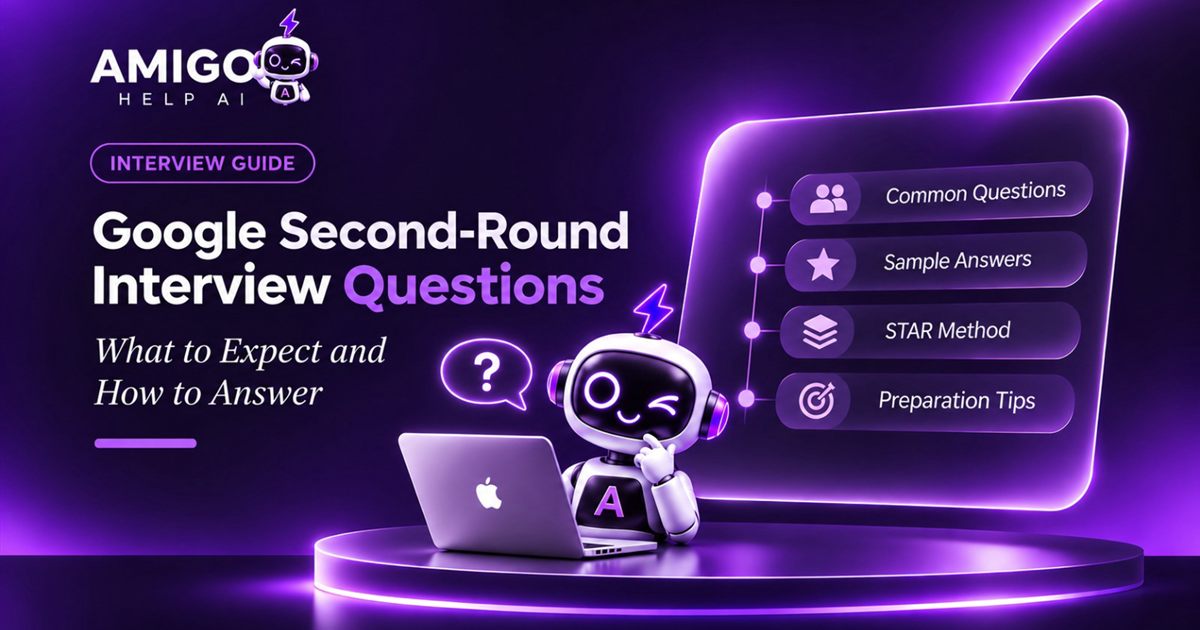
Getting invited to a second-round interview is an encouraging step in your job search. It means your application and initial conversation have made a positive impression. However, the next stage often requires more detailed preparation, stronger examples and a clearer understanding of the role. Whether you are a recent graduate, an experienced professional or someone switching careers, knowing what to expect can help you approach the next conversation with greater confidence. In this guide, we explore common second-round interview questions, sample answers, preparation strategies and practical ways to make a strong impression.
Unlike an initial screening interview, a second-round interview may explore your professional experience, technical knowledge, problem-solving abilities and suitability for the team in greater depth.
What Is a Second-Round Interview?
A second-round interview is the next stage of an employer's hiring process after an initial screening or interview. While the first interview often focuses on your background, qualifications and general suitability, the second round typically examines how well your experience and abilities match the position.
Depending on the company and role, you may meet:
Hiring managers
Department heads
Technical team members
Senior leadership
Potential colleagues
The format can also vary. Some employers conduct individual interviews, while others organise panel discussions, technical assessments, case studies or practical assignments.
The main objective
Employers want to understand how you approach responsibilities, communicate ideas and contribute to the organisation.
What to Expect in a Second-Round Interview
A second interview generally involves more specific discussions about your professional capabilities. Here are some common areas employers may explore.
Technical knowledge
For technical positions, interviewers may ask detailed questions about programming languages, tools, systems, industry knowledge or previous projects. For example, a software developer may be asked to explain how they approached a particular development challenge.
Behavioural questions
Employers want to understand how you respond to real workplace situations. Questions may focus on teamwork, leadership, communication, adaptability and problem-solving.
Previous experience
You may be asked to explain your previous responsibilities, achievements and the impact of your work. Prepare specific examples rather than relying on general statements.
Role and company fit
Interviewers may explore why you want the position, what you understand about the organisation and how your professional goals align with the opportunity.
Understanding these areas can help you prepare more relevant answers.
15 Common Second-Round Interview Questions and Sample Answers
Preparing for frequently asked questions can help you organise your thoughts and communicate your experience more clearly. Below are 15 questions, along with sample answers you can adapt to your own background.
1. Tell me about a project you are particularly proud of.
What the interviewer wants to know: Your contribution, problem-solving ability and understanding of project outcomes.
Sample answer: “One project I particularly enjoyed working on involved developing a solution to improve an existing workflow. I was responsible for understanding the requirements, planning the implementation and coordinating the different tasks. We successfully completed the project and improved the overall process. It also helped me develop stronger problem-solving and collaboration skills.”
2. What was the biggest challenge in your previous role?
What the interviewer wants to know: How you approach challenges and respond to unexpected situations.
Sample answer: “One significant challenge was managing multiple priorities within a limited timeframe. I addressed it by breaking the work into smaller tasks, identifying the most important deliverables and communicating progress regularly. This helped me stay organised and complete the responsibilities effectively.”
3. How do you handle tight deadlines?
What the interviewer wants to know: Your time-management and prioritisation skills.
Sample answer: “I begin by understanding the expected outcome and identifying the tasks that have the greatest impact. I then organise my work according to priority and allocate time accordingly. If I identify a potential delay, I communicate it early rather than waiting until the deadline.”
4. Describe a time you disagreed with a team member.
What the interviewer wants to know: Your communication, teamwork and conflict-resolution abilities.
Sample answer: “During a team project, we had different opinions about how to approach a particular task. Instead of immediately choosing one approach, we discussed the advantages and limitations of each option. We eventually agreed on a solution that addressed the project requirements. The experience taught me the importance of listening and considering different perspectives.”
5. What did you learn from your previous experience?
What the interviewer wants to know: Your ability to reflect and improve.
Sample answer: “My previous experience helped me understand the importance of communication, planning and taking ownership of responsibilities. I also learned that asking questions early and seeking feedback can prevent unnecessary delays and improve the quality of work.”
6. How do you prioritise multiple responsibilities?
What the interviewer wants to know: Your organisational and decision-making skills.
Sample answer: “I consider deadlines, business impact and dependencies before prioritising tasks. I maintain a clear task list and regularly review my progress. If priorities change, I adjust my schedule and communicate with the relevant team members.”
7. Why do you want to work with our company?
What the interviewer wants to know: Whether you have researched the organisation and understand the opportunity.
Sample answer: “I am interested in this opportunity because the role aligns with my skills and professional interests. I have also explored the company's work and the direction it is taking. I believe this position would allow me to contribute meaningfully while continuing to develop professionally.”
8. How do you handle constructive feedback?
What the interviewer wants to know: Your willingness to learn and improve.
Sample answer: “I consider constructive feedback an important part of professional development. I try to understand the feedback, identify what needs improvement and apply the suggestions to my work. I also follow up to understand whether the changes have been effective.”
9. What are your greatest professional strengths?
What the interviewer wants to know: Your understanding of your capabilities.
Sample answer: “My key strengths include problem-solving, adaptability and communication. I enjoy understanding challenges, breaking them into manageable steps and working with others to find practical solutions.”
10. Tell me about a mistake you made and what you learned.
What the interviewer wants to know: Accountability and learning ability.
Sample answer: “During an earlier project, I underestimated the time required for one of the tasks. This affected the original schedule. I took responsibility, reorganised the remaining work and communicated the updated timeline. Since then, I have become more careful about estimating time and identifying potential risks.”
11. How would you approach a new and unfamiliar task?
What the interviewer wants to know: Your ability to learn independently and adapt.
Sample answer: “I would first understand the expected outcome and identify what I already know about the task. I would then research the unfamiliar areas, consult relevant resources and ask for clarification when necessary. I prefer to break unfamiliar work into smaller steps and review my progress as I go.”
12. Where do you see yourself in the next three to five years?
What the interviewer wants to know: Your career direction and professional ambitions.
Sample answer: “I would like to develop deeper expertise in my field, take ownership of more complex responsibilities and contribute to meaningful projects. I also want to strengthen my ability to collaborate and eventually support the development of other team members.”
13. What would you do if you disagreed with your manager?
What the interviewer wants to know: Your professional communication and judgement.
Sample answer: “I would first understand the reasoning behind the decision and then explain my perspective using relevant information. I believe professional disagreements should be handled through respectful discussion. Once a decision is made, I would focus on supporting the agreed direction.”
14. Why should we select you for this position?
What the interviewer wants to know: Whether you can connect your skills to the company's requirements.
Sample answer: “I believe my skills, willingness to learn and approach to problem-solving make me a suitable candidate. I have reviewed the responsibilities of this position and understand the expectations. I would bring a responsible attitude, a collaborative mindset and a genuine interest in contributing to the team.”
15. Do you have any questions for us?
What the interviewer wants to know: Your interest in the role and understanding of the organisation.
Questions you can ask include:
What would success look like in this position during the first three months?
What are the biggest challenges currently facing the team?
How does the company support professional development?
What are the next steps in the selection process?
Asking thoughtful questions helps make the conversation more engaging and gives you a better understanding of the opportunity.
How to Structure Your Answers Using the STAR Method
One of the most useful techniques for answering behavioural interview questions is the STAR method. It helps you organise your responses into four clear stages:
S — Situation
- Explain the background or context.
T — Task
- Describe the responsibility or challenge you faced.
A — Action
- Explain the steps you personally took.
R — Result
- Describe the outcome and what you learned.
For example, if an interviewer asks you to describe a time you solved a problem, you can use the STAR framework to explain the situation without giving an unnecessarily long response. The key is to focus on your individual contribution and provide specific examples wherever possible.
How to Prepare for a Second-Round Interview
Preparation should go beyond simply memorising common interview answers. Here are seven practical steps to help you prepare.
Review your first interview
Think about the questions discussed during your first interview. Identify areas where you could provide more detailed explanations or examples.
Research the company
Understand the organisation's products, services, industry, recent developments and company culture. This can help you provide more relevant answers when discussing why you want to join.
Revisit the job description
Review the responsibilities, qualifications and technical skills mentioned in the job description. Identify how your experience connects with the expectations of the position.
Prepare real examples
Think of examples that demonstrate teamwork, leadership, problem-solving, adaptability and professional achievements. Use the STAR method to organise these examples.
Practise technical questions
If you are applying for a technical position, revisit the tools, technologies and concepts mentioned in the job description. Practise explaining your approach rather than simply memorising definitions.
Prepare questions for the interviewer
Write down a few thoughtful questions about the team, role expectations, work environment and future responsibilities.
Conduct a mock interview
Practising through a mock interview can help you become more comfortable with different question formats. It also gives you an opportunity to identify areas where your answers need improvement.
Common Mistakes to Avoid in a Second-Round Interview
Even well-prepared candidates can make mistakes that affect the overall impression they create. Watch out for these common issues:
Repeating generic answers. Provide specific examples instead of relying on memorised responses.
Not researching the company. Demonstrate that you understand the organisation and its work.
Exaggerating achievements. Be accurate about your responsibilities and contributions.
Giving unnecessarily long answers. Keep your responses structured and relevant.
Ignoring the job description. Connect your skills and experience to the actual requirements.
Not asking questions. Use the opportunity to understand the role better.
Failing to follow up. A short, professional thank-you message can help close the conversation positively.
Clarity matters more than perfection
The objective is not to deliver perfect answers. It is to communicate your abilities, experience and thought process clearly.
How AI Tools Can Help You Prepare for Interviews
Preparing for interviews can become easier when you use AI tools as part of your learning process. AI-powered career tools can help candidates organise their preparation and practise different interview scenarios.
For example, you can use AI tools to:
Generate role-specific interview questions.
Practise behavioural and technical questions.
Review your sample answers.
Identify missing details in your responses.
Organise your professional experiences.
Prepare questions based on a job description.
AmigoHelp.ai is designed to support different stages of the job search journey, including resume building, job matching and interview preparation. Its interview preparation features provide role-specific questions and feedback to help candidates practise before an actual interview.
Use AI as a practice companion
AI should be treated as a practice and learning companion. Your actual interview answers should reflect your genuine experience, knowledge and abilities.
Practise for your second-round interview
Explore AmigoHelp.ai to discover how AI-powered career tools can support your preparation.
Explore AmigoHelp.ai →Second-Round Interview Preparation Checklist
Before attending your interview, use this checklist to make sure you have covered the important areas.
Reviewed the first interview and identified areas for improvement.
Researched the company and its recent developments.
Read the job description again.
Prepared examples of previous projects and achievements.
Practised common behavioural questions.
Reviewed relevant technical concepts.
Prepared thoughtful questions for the interviewer.
Checked the interview time, location or meeting link.
Tested your audio and video equipment if the interview is online.
Prepared a professional introduction.
A simple preparation checklist can help you stay organised and avoid last-minute confusion.
Frequently Asked Questions
What is usually asked in a second-round interview?
Second-round interviews commonly include behavioural questions, technical discussions, questions about previous projects, problem-solving scenarios and questions about your suitability for the position.
Is a second-round interview harder than the first?
It can be more detailed because employers may explore your experience and capabilities more closely. However, the difficulty depends on the role, company and interview format.
How long does a second-round interview usually last?
A second-round interview may last between 30 minutes and an hour, although technical assessments, panel discussions and case interviews can take longer.
How should I prepare for a second-round interview?
Research the company, review the job description, prepare examples of your previous work, practise common questions and prepare questions for the interviewer.
What is the difference between a first-round and second-round interview?
The first round often focuses on initial screening and general suitability. The second round typically explores your skills, experience, problem-solving abilities and fit for the role in greater detail.
What questions should I ask during a second-round interview?
You can ask about role expectations, team responsibilities, performance measurements, professional development and the challenges associated with the position.
Can freshers have a second-round interview?
Yes. Freshers can have multiple interview rounds too. Employers may focus on academic projects, internships, technical knowledge, communication and willingness to learn.
Does reaching the second interview mean I will get the job?
Not necessarily. It means you have progressed to another stage of the selection process. Employers may still be evaluating multiple candidates before making a final decision.
Final Thoughts
A second-round interview is an opportunity to demonstrate more than what is written on your resume. It allows employers to understand your experience, decision-making abilities, communication skills and suitability for the role.
By researching the company, preparing meaningful examples, practising common questions and using structured answer techniques such as STAR, you can approach the next stage with better preparation.
Remember that successful interviews are not about memorising perfect responses. They are about communicating your genuine capabilities with clarity and confidence. Prepare smarter. Practise consistently. Move forward with confidence.
From job search to interview day
Explore AmigoHelp.ai and discover tools designed to support your journey from job search to interview preparation.
Explore AmigoHelp.ai →Frequently Asked Questions
What is usually asked in a second-round interview?
Second-round interviews commonly include behavioural questions, technical discussions, questions about previous projects, problem-solving scenarios and questions about your suitability for the position.
Is a second-round interview harder than the first?
It can be more detailed because employers may explore your experience and capabilities more closely. However, the difficulty depends on the role, company and interview format.
How long does a second-round interview usually last?
A second-round interview may last between 30 minutes and an hour, although technical assessments, panel discussions and case interviews can take longer.
How should I prepare for a second-round interview?
Research the company, review the job description, prepare examples of your previous work, practise common questions and prepare questions for the interviewer.
What is the difference between a first-round and second-round interview?
The first round often focuses on initial screening and general suitability. The second round typically explores your skills, experience, problem-solving abilities and fit for the role in greater detail.
What questions should I ask during a second-round interview?
You can ask about role expectations, team responsibilities, performance measurements, professional development and the challenges associated with the position.
Can freshers have a second-round interview?
Yes. Freshers can have multiple interview rounds too. Employers may focus on academic projects, internships, technical knowledge, communication and willingness to learn.
Does reaching the second interview mean I will get the job?
Not necessarily. It means you have progressed to another stage of the selection process. Employers may still be evaluating multiple candidates before making a final decision.
Found this useful?
Share it with someone preparing for an interview.