Getting an interview opportunity at Google is exciting, but knowing what comes next can feel overwhelming. How many rounds should you expect? What kind of questions will interviewers ask? Is the process different for fresh graduates and experienced professionals? Google's recruitment process varies depending on the position, experience level and hiring team. However, understanding the stages you may encounter — from the initial application to the final hiring decision — can make preparation much easier. This guide walks through the Google interview process in 2026 and shares practical ways to prepare with confidence.
Understanding the Google Hiring Process
Google looks for candidates who can demonstrate the skills, knowledge and experience required for a particular role. The hiring process is designed to evaluate these qualities through different stages of assessment and interviews.
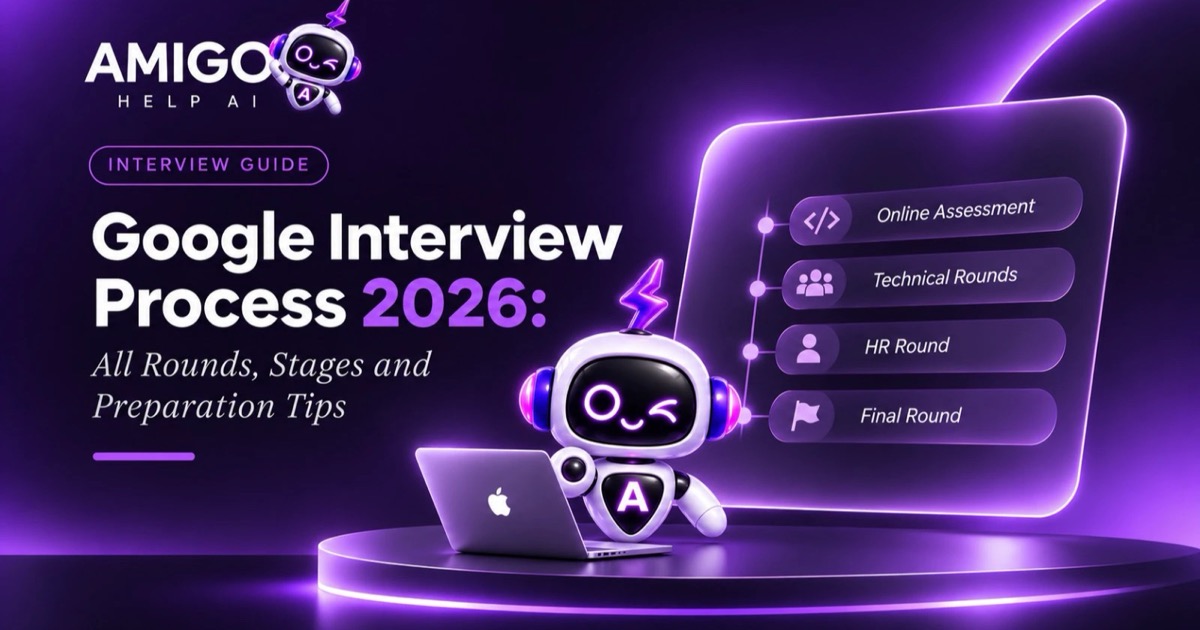
Although the exact sequence isn't the same for everyone, a typical recruitment journey may include:
Application and resume screening. Recruiters review your application and how your experience aligns with the role.
Online assessment. Where applicable, candidates may complete a coding exercise or another role-specific assessment.
Initial recruiter conversation. A recruiter may discuss your background, interests and suitability for the position.
Technical or role-specific interviews. Interviewers assess the knowledge and skills needed for the job.
Behavioural interviews. The hiring team may explore how you communicate, collaborate and handle challenges.
Final evaluation and hiring decision. Interview feedback is reviewed before the hiring team communicates the outcome.
There isn't one fixed interview format for every Google role
Application and Resume Screening
Your journey begins with finding a suitable opening through Google Careers and submitting an application. Before applying, take time to understand the job description. Look beyond the job title and identify the actual skills, qualifications and responsibilities expected from the candidate.
Your resume should make the most relevant details easy to find. Consider highlighting:
Education and qualifications. Include relevant academic background and qualifications.
Technical or professional skills. Make the skills that match the job requirements easy to identify.
Internships and previous work experience. Show the responsibilities you handled and the experience you gained.
Personal and academic projects. Choose projects that demonstrate practical ability and role-related knowledge.
Achievements. Include accomplishments that provide evidence of your abilities.
One common mistake is sending the same resume for every job application. A better approach is to highlight the experience most relevant to the position. A software engineering applicant could focus on programming projects, technical knowledge and problem-solving experience. Someone applying for a business role could emphasise communication, research, analytical skills and project outcomes. Keep your resume clear, honest and easy to scan.
Online Assessments
Depending on the role, candidates may be asked to complete an online assessment before moving forward. For technical positions, this could involve coding problems or other exercises that evaluate programming knowledge and logical thinking.
Useful areas to revise for technical assessments include:
Core foundations
- Data structures and algorithms
- Arrays, strings and linked lists
- Trees and graphs
Problem-solving
- Sorting and searching
- Recursion and dynamic programming
- Time and space complexity
Don't limit your preparation to memorising solutions. Try to understand why a particular approach works and whether there is a more efficient way to solve the problem. For non-technical positions, assessments may focus on analytical ability, role-specific knowledge or practical business scenarios.
An online assessment may not be required for every role
Recruiter Screening
If your application moves forward, you may hear from a recruiter for an introductory conversation. This is generally an opportunity for the recruitment team to understand your background, interests and suitability for the position. It also gives you a chance to ask questions about the role and the next steps.
You may be asked questions such as:
Can you briefly introduce yourself?
Why are you interested in working at Google?
What experience do you have that relates to this position?
Which skills would you bring to the team?
What are you looking for in your next opportunity?
You don't need complicated answers. A clear introduction covering your education or experience, relevant skills and career interests is a good starting point. Also, make sure you understand the projects and responsibilities mentioned in your resume. Recruiters may ask you to explain them in more detail.
Technical Interview Rounds
For software engineering and other technical positions, technical interviews are an important part of the evaluation process. These interviews are not simply about reaching the correct answer. Interviewers may also want to understand how you approach unfamiliar problems, organise your thoughts and explain your decisions.
Coding and programming
Candidates may be given a programming problem and asked to develop a solution. The discussion can involve understanding the requirements, choosing an approach, writing code and considering possible edge cases. Practise writing clean, understandable code rather than relying entirely on memorised solutions.
Data structures and algorithms
A strong understanding of data structures and algorithms is useful for many software engineering interviews. Focus on understanding how different structures work, when they are useful and how your choice affects performance.
System design
Depending on the position and experience level, candidates may also be asked system design questions. These discussions explore how software systems are planned and built. Topics can include databases, APIs, scalability, reliability and communication between different components.
Match your preparation to the role
Behavioural Interviews
Technical knowledge matters, but professional success also depends on how people work with others, communicate and handle challenges. Behavioural interviews help interviewers understand these qualities through situations from your previous work, internships, education or projects.
Some examples include:
Tell me about a challenging project you worked on.
Describe a time you had to solve a difficult problem.
How do you handle disagreements within a team?
Tell me about a mistake you made and what you learned.
Describe a situation where you had to adapt to unexpected changes.
A useful way to structure your responses is the STAR method:
S — Situation
- Explain the background and context.
T — Task
- Describe your responsibility or the challenge.
A — Action
- Explain the steps you personally took.
R — Result
- Share the outcome and what you learned.
When discussing a challenging project, don't just describe the project itself. Explain the problem you faced, the decisions you made and how your contribution helped achieve the outcome. Specific examples make answers more meaningful than generic statements.
Final Evaluation and Hiring Decision
After the required interviews are completed, the hiring team reviews the feedback and evaluates the candidate against the requirements of the position. Depending on the role, there may be further discussions or assessments before a final decision is made.
If selected, the recruiter will communicate the next steps, which may include an offer and relevant employment details. Completing all interview rounds does not automatically guarantee selection. The final outcome depends on the overall evaluation and the requirements of the hiring team.
If you don't receive an immediate update, follow the communication timeline provided by your recruiter rather than assuming the outcome.
How to Prepare for a Google Interview in 2026
Preparing for a competitive interview takes time, but it doesn't have to become complicated. A focused preparation plan is usually more useful than trying to study everything at once. Here are five practical steps to get started.
Understand the role first
Read the job description carefully and identify the skills you need to demonstrate. Your preparation should match the position you are applying for.
Practise relevant questions
For technical positions, spend time solving coding problems and explaining your approach. For other roles, practise analytical, situational and behavioural questions.
Take mock interviews
Mock interviews help you become comfortable answering questions under time constraints. They also reveal areas where you may need more practice.
Improve how you communicate
Knowing an answer is one thing; explaining it clearly is another. Practise describing your thought process, especially when solving technical problems.
Review your resume
Be prepared to discuss the projects, achievements and skills you have mentioned. Interviewers may ask detailed follow-up questions, so make sure you understand your own experience.
Consistency matters more than cramming
How AmigoHelp.ai Can Support Your Interview Preparation
Preparing for interviews often means managing several things at once: practising questions, improving your answers, revising technical topics and preparing your resume. Having a structured way to practise can make the process easier.
AmigoHelp.ai aims to support candidates through AI-powered career and interview preparation tools. Depending on the features available on the platform, candidates can explore AI assistance to practise questions, organise their preparation and improve the way they communicate their answers.
AI can be a useful practice partner, particularly when you want to explore different questions or get another perspective on an answer. However, it shouldn't replace genuine preparation. Understanding concepts, gaining practical experience and developing your own problem-solving ability remain essential.
Prepare for your next interview with more confidence
Explore AmigoHelp.ai and learn more about the career and interview preparation tools available on the platform.
Try Amigo free →Frequently Asked Questions
How many rounds are there in a Google interview?
There is no fixed number of rounds for every position. The process depends on the role, experience level and hiring team. A typical process may include screening, assessments where applicable, recruiter conversations and role-specific interviews.
Is Google's interview process different for freshers and experienced professionals?
Yes. The areas of evaluation may differ depending on experience. Entry-level candidates may be assessed on foundational knowledge, while experienced professionals may face more advanced role-specific discussions.
What should I study for a Google software engineering interview?
Start with programming fundamentals, data structures, algorithms and problem-solving. System design may also be relevant depending on the position and experience level.
Are behavioural questions part of Google interviews?
Behavioural questions may be included to understand how candidates communicate, collaborate, handle challenges and approach workplace situations. Prepare specific examples and structure them using the STAR method.
Does every Google candidate have to complete an online assessment?
No. Online assessments depend on the position and recruitment process. Candidates should follow the instructions provided during their application process.
Can AI tools help with interview preparation?
Yes. AI tools can help candidates practise questions, organise study topics and improve answer clarity. However, candidates should develop their own understanding and be able to answer independently.
Final Thoughts
The Google interview process may seem challenging at first, but knowing what to expect makes it easier to approach each stage with a clear plan. Start by understanding the role, build a strong resume, practise relevant questions and spend time improving your communication. Most importantly, focus on understanding concepts instead of memorising answers.
A successful interview is not just about knowing the right answers. It's about showing how you think, solve problems and contribute to a team. With consistent preparation and the right approach, you can make your next interview a much more confident experience.
Found this useful?
Share it with someone preparing for an interview.