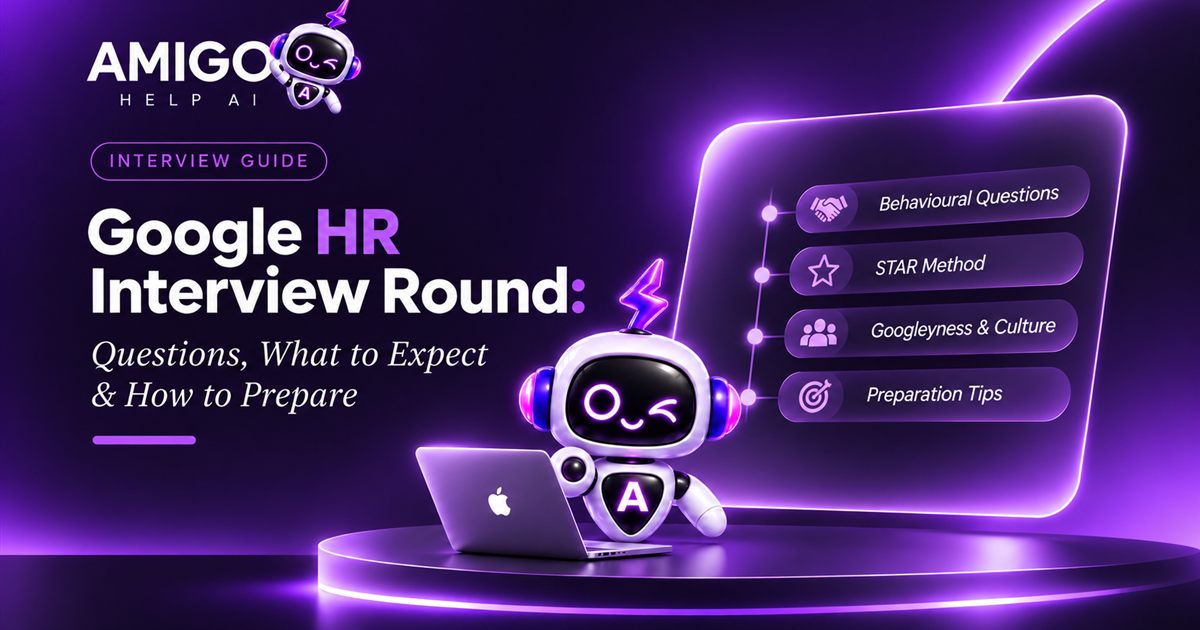
Preparing for a Google interview requires more than technical knowledge. While the earlier rounds may focus on technical expertise, problem-solving and role-specific skills, the HR or behavioural interview gives recruiters an opportunity to understand your personality, communication style, professional values and approach to working with others. In this guide, we explore common Google HR interview questions, answer strategies, the STAR method and practical preparation tips to help you approach the interview with confidence.
This is an important part of the broader Google interview process. After understanding the initial stages and preparing for the different interview rounds, candidates should also prepare for behavioural conversations and questions about their professional experiences.
What Is the Google HR Interview Round?
The HR or behavioural interview is designed to understand how candidates approach workplace situations, communicate with colleagues, handle challenges and contribute to a team.
During behavioural conversations, interviewers may explore areas such as:
Communication and interpersonal skills
Teamwork and collaboration
Leadership and ownership
Adaptability and decision-making
Problem-solving abilities
Motivation and career goals
The structure varies by role
Google's interview structure can vary depending on the role, team and hiring requirements. Candidates should not assume that every position follows exactly the same three-round sequence.
Understanding the different types of behavioural interview questions can help candidates prepare relevant examples from their academic, professional and personal experiences. For a broader collection of examples, explore AmigoHelp's 50 Behavioural Interview Questions With Sample Answers.
What Does Google Look for in Candidates?
Google evaluates candidates across several dimensions. The specific criteria depend on the position, but the following qualities are useful to understand.
Googleyness and collaboration
Googleyness broadly relates to qualities such as curiosity, adaptability, collaboration, respect and a willingness to learn. Interviewers may ask about situations where you worked with people who had different opinions or approaches. For example, questions about handling workplace disagreements can help demonstrate your ability to listen, communicate and work towards a common outcome.
Leadership and ownership
Leadership does not always mean managing a team. It can also mean taking responsibility, identifying problems and helping others achieve shared goals. Prepare examples that demonstrate how you took initiative or accepted responsibility for an outcome.
Problem-solving and adaptability
Interviewers may explore how you respond when plans change, unexpected challenges arise or information is incomplete. You can prepare by reviewing common behavioural interview questions and answers and identifying real examples that demonstrate your approach.
Communication skills
Clear communication is important in almost every professional role. Your answers should be structured, relevant and easy to understand. You can also practise presenting your experiences clearly using Amigo's AI-powered interview preparation resources.
Common Google HR Interview Questions and How to Answer Them
Here are some questions you may encounter during a Google behavioural or HR interview.
1. Tell me about yourself
This is often used to begin an interview. The interviewer wants to understand your background, experience, interests and professional direction.
How to answer:
Start with a brief introduction.
Mention your educational or professional background.
Highlight relevant skills and achievements.
Explain your current career interests.
Avoid repeating your entire resume. Instead, create a concise introduction that connects your experience to the position. For a more structured approach, explore our guide on How to Answer Tell Me About Yourself.
2. Why do you want to work at Google?
The interviewer wants to understand your motivation and whether you have researched the organisation.
How to answer: Discuss Google's products, work environment, innovation or opportunities to contribute to meaningful projects. Connect these points with your own professional interests. Avoid giving generic answers such as wanting to work for a famous company.
You can also learn how to structure answers to Why Do You Want to Work Here? to make your response more specific.
3. What are your greatest strengths and weaknesses?
This question evaluates self-awareness and your willingness to improve.
How to answer: Choose strengths that are relevant to the position and support them with examples. When discussing a weakness, mention what you are doing to improve it rather than presenting it as an unchangeable limitation.
4. Tell me about a time you faced a challenge
Interviewers use this question to understand how you approach difficult situations.
How to answer: Explain the situation, identify the challenge, describe the actions you took and share the outcome. Prepare examples from academic projects, internships, professional responsibilities or team activities.
For additional practice, review these behavioural interview questions.
5. How do you handle disagreements within a team?
This question evaluates your collaboration and communication skills.
How to answer: Describe a genuine situation where people had different opinions. Explain how you listened, discussed the alternatives and worked towards a practical solution. Focus on teamwork rather than proving that your opinion was correct.
6. Where do you see yourself in five years?
The interviewer wants to understand your career direction and professional ambitions.
How to answer: Discuss the skills you want to develop, the responsibilities you hope to take on and how the position fits into your long-term goals. Keep your answer realistic and connected to the role.
7. Tell me about a mistake you made
This question helps interviewers understand accountability and learning.
How to answer: Choose a genuine professional or academic example. Explain what happened, what you learned and what you changed afterwards. Avoid blaming other people or pretending you have never made a mistake.
You can also prepare for behavioural questions about failure and challenging experiences.
8. Why should we hire you?
This is an opportunity to connect your skills, experience and strengths with the position.
How to answer: Highlight two or three relevant qualities and support them with examples. Explain how your abilities could contribute to the team.
For more examples, read our guide on How to Answer Why Should We Hire You?
Practise beyond these eight questions
For more questions across companies, roles and interview rounds, visit the AmigoHelp Interview Questions Library.
How to Use the STAR Method in Google HR Interviews
The STAR method is a useful framework for answering behavioural interview questions. It helps you organise your response so that the interviewer can understand the situation and your contribution.
S — Situation
- Explain the background or context.
T — Task
- Describe the responsibility or challenge.
A — Action
- Explain the steps you personally took.
R — Result
- Share the outcome and what you learned.
Example: Tell me about a time you worked under pressure
Situation: During a college project, our team had limited time to complete an important assignment.
Task: I was responsible for coordinating the research and ensuring that our section was completed on schedule.
Action: I divided the work into smaller tasks, communicated regularly with team members and prioritised the most important activities.
Result: We completed the project within the deadline and improved the way we coordinated our work.
The STAR framework helps you avoid vague answers and communicate your contribution clearly. For more examples, explore AmigoHelp's Behavioural Interview Questions and STAR Method Answer Guide. You can also read How to Explain a Project in an Interview Without Rambling to understand how to communicate your individual contributions effectively.
Questions You Can Ask the Google Interviewer
An interview is also an opportunity for you to understand the role and the organisation. At the end of the conversation, you may be asked whether you have any questions. Here are a few useful examples:
What does success look like in this position during the first six months?
How does the team collaborate across different departments?
What are some important challenges the team is currently working on?
What learning and development opportunities are available?
How would you describe the team's working culture?
Choose questions that genuinely help you understand the position. Avoid asking questions that have already been answered during the interview. For additional company-specific preparation, you can also explore the Google Interview Process Guide.
Common Mistakes to Avoid During a Google HR Interview
Even well-prepared candidates can make mistakes that affect the quality of their responses. Avoid these common issues:
Giving memorised answers that sound unnatural.
Providing long answers without a clear structure.
Speaking negatively about previous employers or colleagues.
Taking credit for work completed by an entire team.
Giving examples without explaining your personal contribution.
Failing to research the role and organisation.
Not preparing questions for the interviewer.
Also, make sure your resume accurately reflects your skills and experience. You can use the AmigoHelp AI Resume Builder to understand how to organise your experience and present relevant information clearly. If you need to improve how you describe academic or professional work, read our guide on How to Explain a Project in an Interview.
How to Prepare for the Google HR Interview
Preparation should focus on understanding your own experiences and communicating them effectively.
Research the company and role
Understand Google's products, services, work culture and the responsibilities mentioned in the job description. For a detailed overview of the interview stages, read our Google Interview Process: Rounds, Timeline and Levels. You can also understand recent changes in Google's technical hiring through Google's AI-Assisted Coding Interview Guide.
Prepare your personal examples
Think about situations where you demonstrated teamwork, leadership, problem-solving, adaptability and responsibility. Use the 50 Behavioural Interview Questions guide to identify different situations you should prepare for.
Practise common questions
Prepare answers for frequently asked questions, but avoid memorising them word for word. You can explore the AmigoHelp Interview Question Library to find questions for additional practice.
Practise speaking your answers
Reading answers silently is not the same as explaining them in a conversation. Practise speaking clearly and keeping your responses focused. You can also use AmigoHelp Practice Mode to run mock interview sessions and support your preparation.
Review your resume and projects
Be prepared to explain everything mentioned in your resume, including your responsibilities, achievements and projects. For additional guidance, explore the AmigoHelp AI Resume Builder Guide. You can also learn how Amigo personalises interview suggestions through its AI Copilot Overview.
Prepare questions for the interviewer
Keep a few thoughtful questions ready. This demonstrates preparation and helps you understand whether the role is right for you.
How AmigoHelp.ai Can Help You Prepare
Preparing for an interview becomes easier when you have access to structured questions, practical guidance and opportunities to practise your responses. AmigoHelp.ai provides interview preparation resources that can help candidates improve their confidence and communication.
You can explore the AmigoHelp Interview Question Library to practise common questions and use Practice Mode to support your preparation.
Amigo's AI Copilot is designed to provide personalised interview assistance using your resume, target role and profile information. Learn more through the complete guide to how Amigo works.
You can also explore the AI Resume Builder to understand how to prepare a resume that reflects your experience and the role you are targeting. For a broader look at the changing role of AI in interview preparation, read 5 Ways AI Is Changing How Candidates Prepare for Interviews in 2026.
Prepare thoughtfully, communicate clearly
Practise common questions, run mock interviews and approach your Google HR interview with greater confidence.
Explore AmigoHelp.ai →Final Thoughts
The Google HR interview is an opportunity to demonstrate more than your technical knowledge. It allows interviewers to understand your communication skills, collaboration, professional values and approach to challenges.
Prepare genuine examples, practise the STAR method and research the role before the interview. Most importantly, focus on communicating your experiences naturally instead of memorising answers.
With consistent preparation and the right resources, you can approach your Google HR interview with greater clarity and confidence. Explore more interview preparation resources on the AmigoHelp Blog and discover how Amigo can support your preparation journey.
Found this useful?
Share it with someone preparing for an interview.